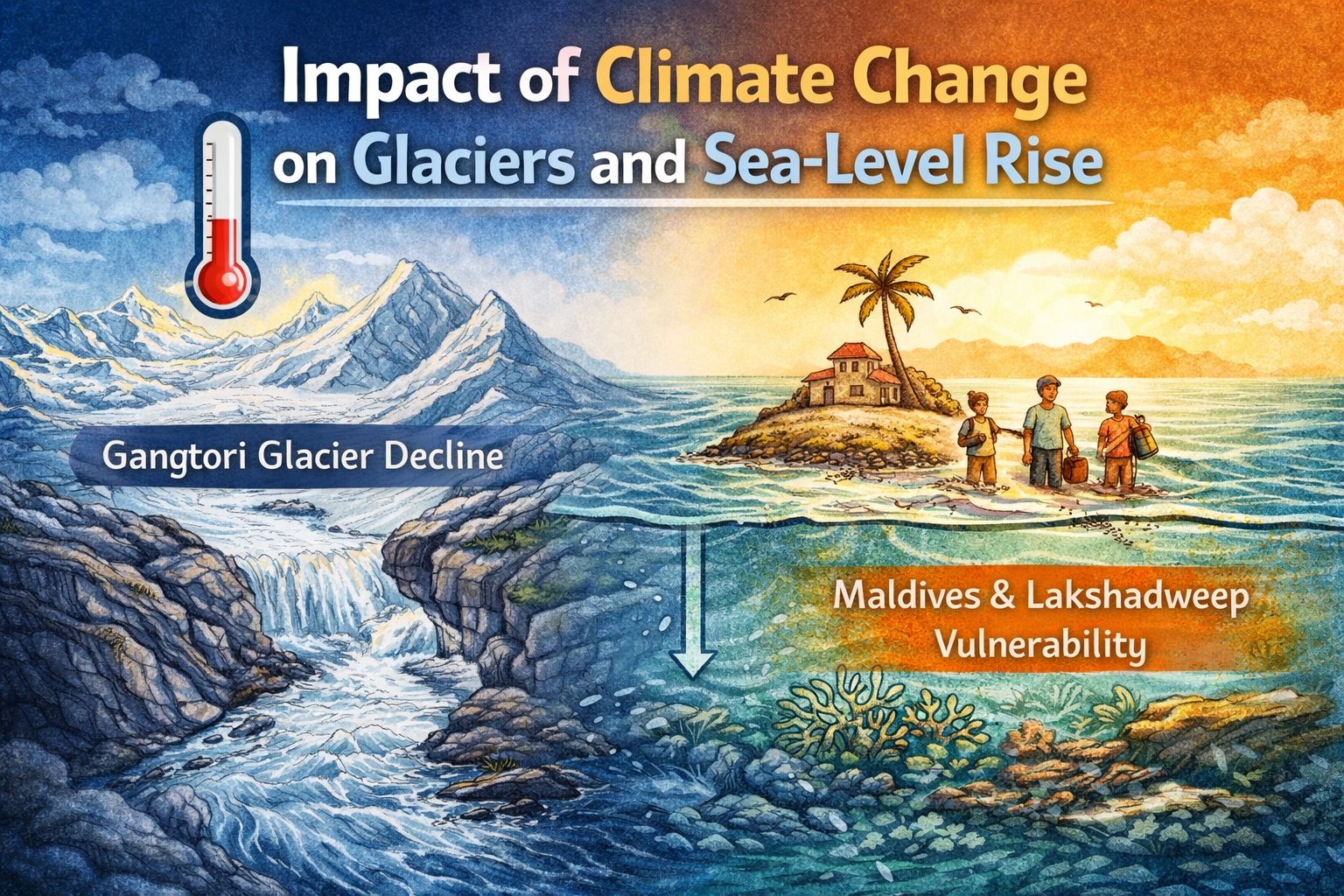
Climate change has significantly accelerated the melting of glaciers and polar ice caps, leading to rising sea levels and associated environmental and socio-economic challenges. Increasing global temperatures, driven by greenhouse gas emissions, have disturbed the natural balance of snow accumulation and melting.
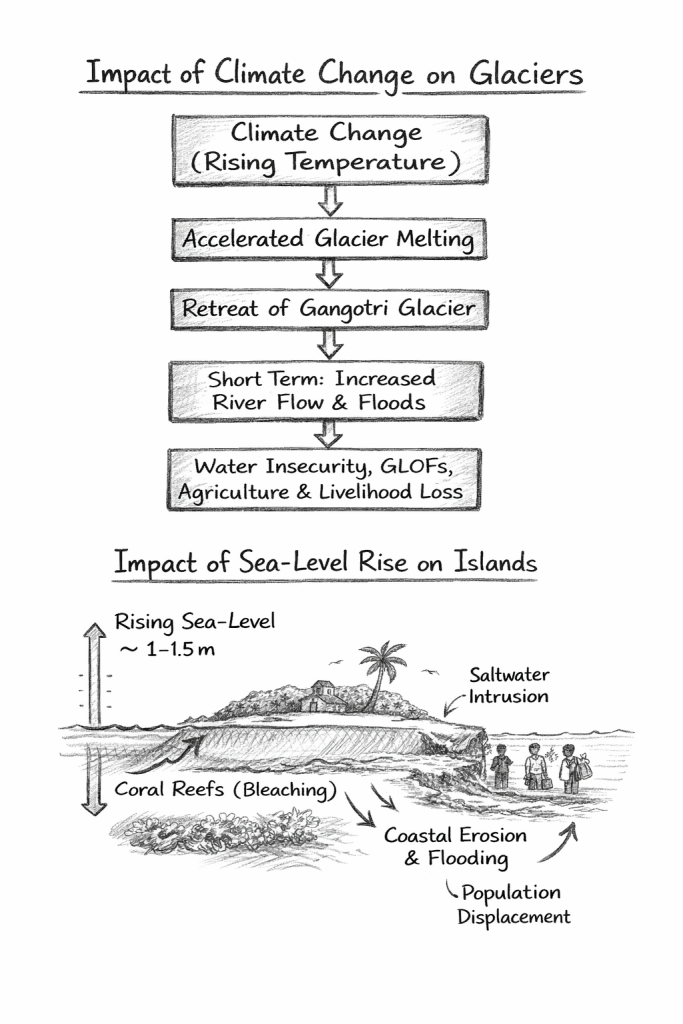
In the Indian context, the Gangotri Glacier, a major source of the River Ganga, has been retreating rapidly. Rising temperatures and declining snowfall have reduced ice mass, threatening long-term water security for millions dependent on the Ganga basin. Initially, glacial melt increases river discharge, but in the long run, it leads to reduced water availability, affecting agriculture, hydropower, and drinking water supply. Moreover, the formation of glacial lakes increases the risk of Glacial Lake Outburst Floods (GLOFs), endangering Himalayan communities.
Globally, glacial and polar ice melt contributes to sea-level rise, compounded by thermal expansion of seawater. This poses an existential threat to low-lying island nations like the Maldives, where average elevation is barely 1–1.5 meters above sea level. Even small rises can cause permanent submergence, displacement, and loss of livelihoods. Similarly, India’s Lakshadweep Islands face coastal erosion, coral bleaching, saltwater intrusion, and threats to fisheries and tourism.
Thus, climate-induced glacial retreat and sea-level rise have far-reaching consequences for water security, ecosystems, livelihoods, and human settlement. Addressing these challenges requires emission reduction, climate-resilient infrastructure, glacier monitoring, and international cooperation to ensure sustainable development.
2️⃣ Diagrams & Flowchart Descriptions (For UPSC Answer)
📌 Diagram 1: Climate Change → Glacial Melt → Impacts
Description:
A flowchart showing:
Rising Global Temperature → Glacier Retreat → Reduced River Flow + GLOFs → Water & Disaster Risks
📌 Diagram 2: Sea-Level Rise Impacts on Islands
Description:
A labeled sketch showing:
- Rising sea level
- Low-lying island (Maldives/Lakshadweep)
- Effects: coastal erosion, flooding, saltwater intrusion