
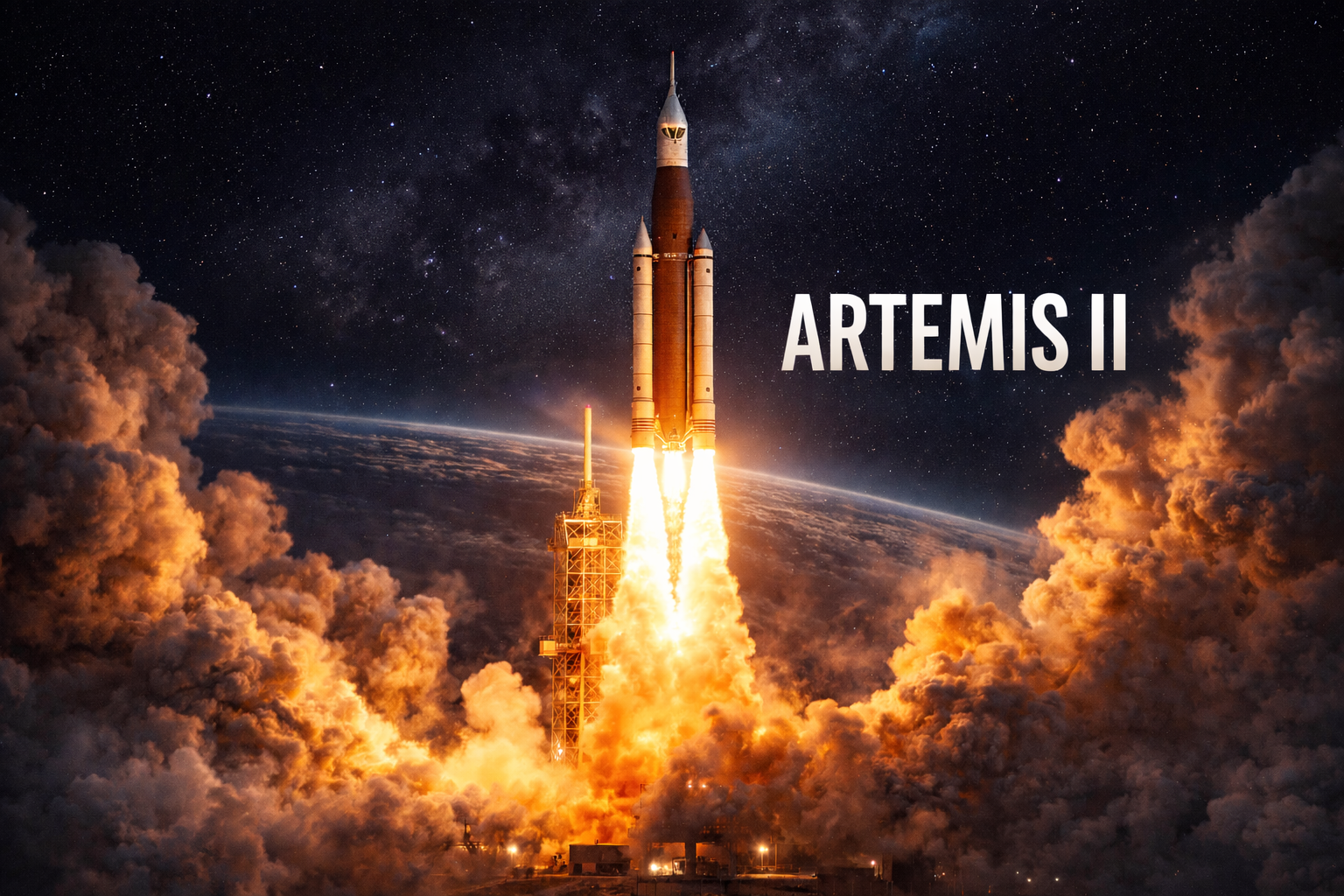
Humanity Has Officially Started Its Return to the Moon
For the first time in more than half a century, humans are once again on a mission around the Moon — and that alone makes NASA’s Artemis II one of the biggest space stories in the world right now. But this mission is much bigger than nostalgia, symbolism, or a repeat of Apollo. Artemis II is not simply a return to old territory. It is the beginning of a new era in human space exploration, one designed not just to revisit the Moon, but to build the systems, partnerships, and confidence needed to eventually live and work beyond Earth. NASA launched Artemis II on April 1, 2026, aboard the Space Launch System rocket from Kennedy Space Center, sending four astronauts on a roughly 10-day mission around the Moon and back. It is the first crewed Artemis mission and the first human lunar voyage in over 50 years.
What makes this mission so compelling is that it combines history, technology, geopolitics, science, and the future of civilization into one dramatic launch. Artemis II is not just a Moon mission. It is a test of whether humanity is truly ready to move beyond low-Earth orbit again — and this time, stay there.
What Is Artemis II?
Artemis II is NASA’s first crewed mission under the Artemis program, the long-term campaign designed to return astronauts to the Moon and eventually use what is learned there to help send humans to Mars. While Artemis I in 2022 successfully tested the Space Launch System and Orion spacecraft without astronauts on board, Artemis II is the first time NASA has placed a human crew inside that system and sent them on a deep-space mission. In simple terms, Artemis II is the dress rehearsal for humanity’s next phase of lunar exploration.
The mission is a crewed lunar flyby rather than a landing. That means the astronauts will not touch down on the Moon during this flight. Instead, they will travel around it and return to Earth after completing a carefully planned test mission. That may sound modest to casual readers, but in reality it is one of the most important spaceflight milestones in modern history. Before astronauts can safely land on the Moon again, NASA must prove that the systems carrying them can perform flawlessly in deep space with human beings on board. Artemis II exists to answer that question.
Why Was Artemis II Launched?
Artemis II was launched because the future of human deep-space travel depends on proving that astronauts can once again travel safely beyond Earth orbit. Since the end of the Apollo era, most human spaceflight has remained relatively close to Earth, particularly aboard the Space Shuttle and the International Space Station. That work was critical, but the Moon and Mars require a completely different level of mission complexity, system durability, and human endurance.
NASA launched Artemis II to test every major system that matters in a real deep-space environment. This includes life support, navigation, communications, propulsion, power systems, crew operations, and the spacecraft’s ability to keep astronauts alive and functional far beyond the safety net of near-Earth orbit. This mission is also meant to validate the human experience of traveling around the Moon inside Orion — not just whether the spacecraft works technically, but whether the crew can live, work, and respond effectively during a real mission profile. According to NASA and Reuters, the mission will also test Orion’s heat shield during its high-speed return to Earth, one of the most critical safety steps before future lunar landing missions.
In other words, Artemis II was launched because if this mission fails, the path to landing astronauts on the Moon again becomes far more uncertain. If it succeeds, it unlocks the next major phase of human exploration.
Why Artemis II Matters More Than Most People Realize
At first glance, some people may wonder why a mission that does not even land on the Moon is being treated as such a major event. The answer is simple: space exploration does not work on spectacle alone. It works on layers of trust built through test after test, mission after mission. Artemis II matters because it is the mission that decides whether the Artemis architecture is truly ready for human use.
This mission is the point where NASA’s Moon program stops being mostly conceptual and becomes human reality. It is one thing to send hardware around the Moon. It is another thing entirely to strap four astronauts into that hardware and ask them to trust it with their lives. That changes everything. It changes public confidence, engineering accountability, political support, international credibility, and the future of every Artemis mission that comes after it.
Artemis II also matters because it is not only about the Moon. NASA has been clear that the Moon is a proving ground for something even bigger: Mars. Deep-space exploration requires technologies and mission designs that cannot be fully tested in low-Earth orbit. The Moon offers the best stepping stone for learning how to build sustainable off-world operations, long-duration crew systems, and mission resilience far from home. Artemis II is therefore not just a Moon mission. It is part of the infrastructure of humanity’s long-term future in space.
The Artemis II Crew Is Making History for More Than One Reason
One of the reasons Artemis II has captured such broad attention online is the extraordinary significance of its crew. NASA selected four astronauts for the mission: Reid Wiseman, Victor Glover, Christina Koch, and Jeremy Hansen of the Canadian Space Agency. That lineup is historically important not only because they are flying farther from Earth than any human crew in decades, but because the mission also represents a major cultural and international milestone in spaceflight.
Christina Koch is the first woman assigned to a lunar mission, while Victor Glover becomes the first Black astronaut to travel on a lunar mission. Jeremy Hansen, representing Canada, is the first non-American astronaut ever assigned to a mission around the Moon. These are not symbolic details to be buried in a press release. They matter because they show that the new age of Moon exploration is being framed not as a narrow national replay of the Apollo era, but as a broader human project with a more representative face.
That alone has helped Artemis II go viral far beyond traditional space audiences. The mission is not only technically ambitious. It is also emotionally resonant. It tells a story of progress, inclusion, and a new generation carrying forward one of humanity’s oldest dreams.
Which Countries Collaborated on Artemis II?
Although Artemis II is led by NASA and launched from the United States, it is not a purely American mission in spirit or structure. The mission represents a growing model of international collaboration in space exploration, and that is one of the reasons it matters geopolitically as well as scientifically.
The most visible international partner on Artemis II is Canada through the Canadian Space Agency, which is represented directly by astronaut Jeremy Hansen on the crew. That participation reflects a long-standing U.S.-Canada partnership in human spaceflight and is part of a broader framework of cooperation that extends across the Artemis program.
Beyond the crew itself, the Artemis program more broadly is tied to a larger international coalition often associated with the Artemis Accords and collaborative work involving agencies such as the European Space Agency, the Japan Aerospace Exploration Agency, and the Canadian Space Agency. These partnerships matter because no serious long-term Moon or Mars effort is likely to be sustainable as a one-country vanity project. Future exploration will depend on shared technology, logistics, scientific coordination, infrastructure, and political commitment.
That means Artemis II is important not only because it sends humans around the Moon, but because it also demonstrates how the next era of exploration may be built: not as a solo race, but as a coalition-driven framework with strategic, scientific, and diplomatic value.
The Rocket and Spacecraft Behind Artemis II Are Central to the Mission’s Future
No article about Artemis II is complete without understanding the two giant machines at the center of the mission: NASA’s Space Launch System, or SLS, and the Orion spacecraft. These are the backbone of Artemis II and the reason the mission is such a major engineering event.
The Space Launch System is NASA’s heavy-lift rocket, built to carry astronauts and deep-space payloads beyond Earth orbit. It is currently the only rocket in NASA’s architecture capable of launching Orion and its crew directly toward the Moon in a single mission profile. Orion, meanwhile, is the spacecraft designed to carry astronauts into deep space, keep them alive during the journey, and bring them safely back home. Artemis II is the first time this combination is being used with human beings aboard.
This is important because SLS and Orion have faced years of scrutiny, delay, and cost criticism. Artemis II is therefore not just a scientific mission. It is also a real-world validation of one of the most ambitious and expensive exploration systems NASA has built in modern times. Reuters has noted that the mission is being watched closely not only as a human spaceflight milestone, but also as a major test of NASA’s legacy aerospace model at a time when commercial players like SpaceX and Blue Origin are reshaping the industry.
That tension gives Artemis II another layer of online virality: it is not just a launch, it is also a referendum on the future direction of space exploration itself.
What Exactly Will Artemis II Do During the Mission?
Artemis II is expected to last about 10 days, and every phase of the mission is designed to collect valuable data for future lunar exploration. After launch, the crew begins by orbiting Earth and conducting critical systems checks. These early operations are not routine formalities. They are a deliberate attempt to verify how the spacecraft behaves with real astronauts on board, including systems tied to life support, navigation, power, and communications.
Once those initial checkouts are completed, Orion performs a trans lunar injection burn that sends it on a path toward the Moon. NASA has already reported that the mission achieved this crucial maneuver after launch, confirming one of the key early milestones of the flight.
The spacecraft will then travel farther from Earth than any human mission in decades, swing around the far side of the Moon, and follow what is known as a free-return trajectory. This is one of the most elegant aspects of the mission design. A free-return path uses the Moon’s gravity to bend the spacecraft back toward Earth naturally, reducing the need for additional propulsion and offering a safer mission architecture for a test flight. On the return journey, the crew will continue evaluating systems before Orion re-enters Earth’s atmosphere at around 25,000 miles per hour. That final phase is especially important because it will test the spacecraft’s heat shield and recovery profile before astronauts are asked to trust it again on future landing missions.
Why the World Is Watching Artemis II So Closely
Artemis II is not only being followed by space enthusiasts. It is being watched by governments, military planners, private aerospace companies, scientists, educators, and millions of ordinary people because it sits at the intersection of science, national ambition, and the future of technology. In an age when geopolitical competition is increasingly extending into space, the Moon is no longer just a symbol of wonder. It is becoming part of the strategic map of the 21st century.
The United States is not the only country with major lunar ambitions. China, for example, has openly accelerated its lunar plans, and that reality gives Artemis II a competitive dimension even if NASA presents the mission primarily in scientific and exploratory terms. Reuters has described Artemis as a major step in the race to return humans to the Moon amid growing international competition over lunar access, capability, and prestige.
That is one reason this story is trending so strongly online. It is not just about astronauts floating in a capsule. It is about who shapes the next era of human presence beyond Earth. And people understand that instinctively, even if they do not follow space policy every week.
What to Expect From Artemis II and the Exploration Ahead
If Artemis II succeeds, it will become the bridge between symbolic return and actual human expansion beyond Earth. The most immediate expectation is that the mission will clear the way for future Artemis missions that move from flyby to landing. NASA’s long-term goal is not simply to orbit or pass by the Moon, but to establish a sustained human presence there, especially near the lunar south pole where water ice may support future exploration and habitation.
That means Artemis II should be understood as a confidence-building mission for everything that comes next. Future missions are expected to test landing systems, surface operations, logistics, habitat concepts, and eventually the kind of infrastructure needed for long-duration exploration. The Moon is being treated not as the final destination, but as the training ground for Mars. The systems, risks, and lessons learned through Artemis will help define whether humanity can one day send astronauts to another planet and bring them back safely.
In practical terms, what readers should expect from Artemis II is not a dramatic landing or moonwalk, but something just as important: proof. Proof that human beings can once again leave Earth orbit and operate safely in deep space. Proof that the hardware works. Proof that the international model can hold. Proof that the next giant leap is no longer theoretical.
Why Artemis II Has Become One of the Most Read and Shared Space Stories Online
There is a reason Artemis II is being widely read, searched, and shared across the internet right now. It has every element that creates modern virality. It is historical, emotional, visually powerful, technologically ambitious, globally relevant, and easy to understand at a human level. People may not all follow orbital mechanics, but they understand what it means when human beings return to the Moon’s neighborhood after more than 50 years.
It also arrives at a moment when the public is hungry for stories that feel bigger than crisis, conflict, and political fatigue. Artemis II offers something rare: a story that is serious, intelligent, and globally important, yet still inspiring. It is a reminder that humanity can still attempt things that are difficult, risky, and magnificent.
That is why Artemis II is not just a NASA story. It is a culture story. It is a future story. And for many people reading it online right now, it feels like the first real chapter in a new space age.
Conclusion: Artemis II Is More Than a Moon Mission — It Is a Test of Humanity’s Next Era
NASA’s Artemis II mission is important because it is the moment where ambition meets reality. It is the mission that asks whether humanity is truly ready to return to deep space with people on board and begin building the foundation for a long-term future beyond Earth. It is historic because it is the first crewed lunar mission in over half a century. It is important because it tests the systems that future Moon landings and Mars missions will depend on. And it is powerful because it turns the dream of exploration back into something immediate, visible, and human.
Artemis II is not just about where four astronauts are going over the next 10 days. It is about where all of us may be going over the next 10, 20, or 50 years. If this mission succeeds, it will not simply mark a return to the Moon. It will mark the beginning of a much bigger journey.
Humans are finally heading back around the Moon. NASA’s Artemis II is more than a launch — it could be the beginning of the next space age. Here’s why the world is watching.