
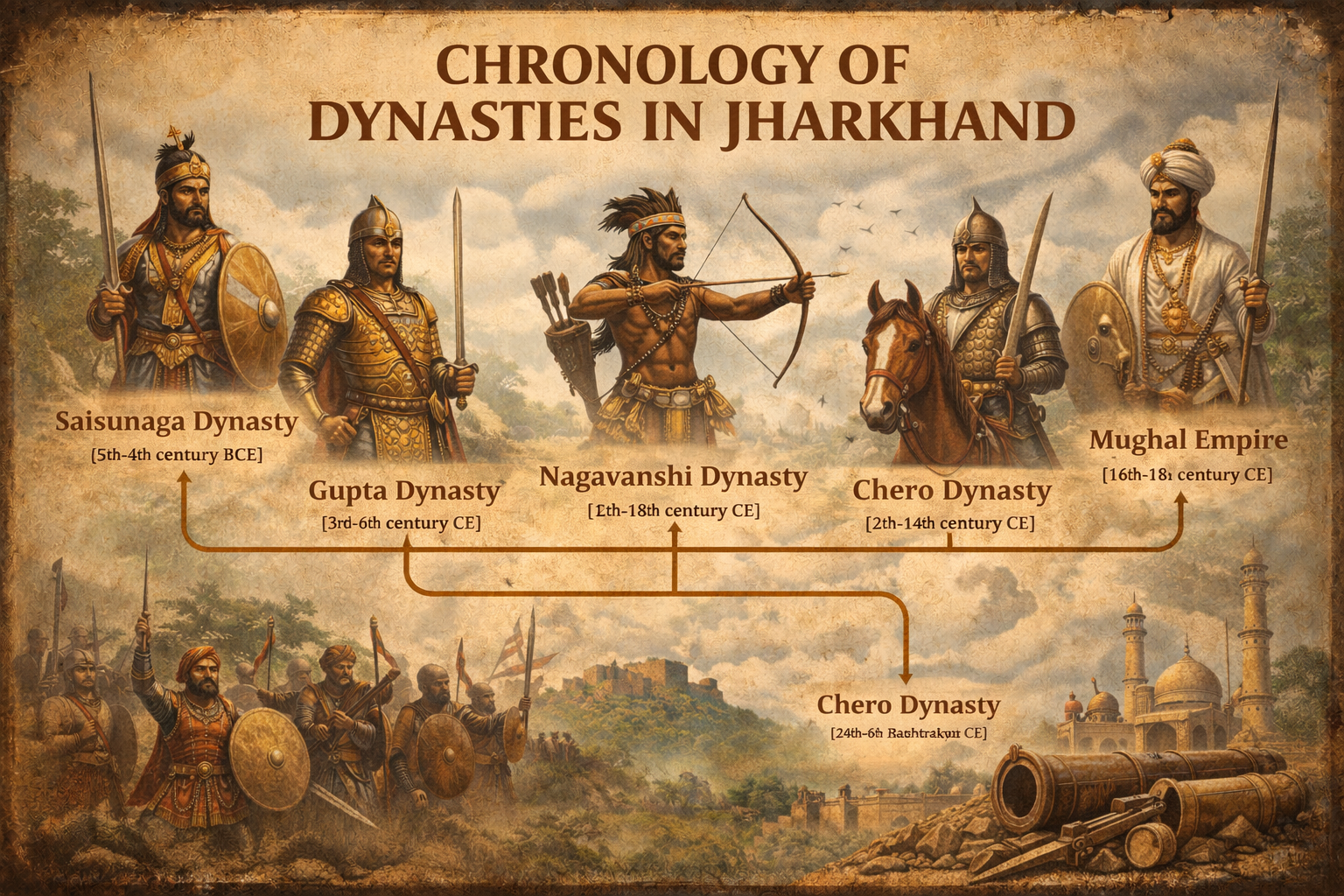
Jharkhand, often called the “Land of Forests,” has a rich historical legacy shaped by indigenous tribal societies, local dynasties, and occasional influences from larger empires. Unlike northern India’s centralized kingdoms, Jharkhand’s rugged terrain and dense forests allowed many regional rulers to maintain significant autonomy for centuries. The region’s history is dominated by tribal-origin dynasties like the Nagvanshi and Chero, alongside lesser-known ones such as the Khayaravala, Ramgarh Raj, and various zamindari estates.
This post provides a comprehensive chronology of the major dynasties that ruled parts of present-day Jharkhand, from ancient influences to the medieval and early modern periods. Dates are approximate, based on inscriptions, local annals (like Nagvanshavali), Mughal records (Akbarnama, Tuzuk-i-Jahangiri), and archaeological evidence. For JPSC/JSSC aspirants, this topic is crucial for General Studies, especially questions on local rulers, Mughal interactions, and tribal resistance.
1. Ancient Period Influences (Pre-500 CE)
Jharkhand was never a core part of large empires but felt their peripheral impact:
- Magadha and Anga Mahajanapadas (~600–321 BCE): Northern fringes under Magadha influence.
- Nanda Empire (321–185 BCE): Extended reach.
- Maurya Empire (322–185 BCE): Ashoka’s Buddhist missions; edicts and influence in nearby areas.
- Gupta Empire (320–550 CE): Cultural and economic prosperity; “Golden Age” impact, but local tribal groups remained semi-independent.
- Pala Empire (750–1174 CE): Eastern influence; 10th-century Buddhist monastery discovered in Hazaribagh.
2. Early Medieval Period (500–1200 CE): Rise of Local Powers
This era saw the emergence of indigenous dynasties amid the decline of larger empires.
- Khayaravala Dynasty (11th–12th centuries CE):
A tribal (likely Kharwar-origin) kingdom ruling parts of southern Bihar and northern Jharkhand (Japla/Japila territory, Khayaragarh capital in Shahabad). They were feudatories of the Gahadavala dynasty of Varanasi. - Key ruler: Pratapadhavala (mid-12th century) – Expanded territory; left rock inscriptions; claimed Kshatriya status and patronized Brahmanical worship (Chandi as tutelary deity).
- Decline: Likely overshadowed by neighboring powers or internal issues; transitioned from tribal to territorial sovereignty.
- Early Nagvanshi Dynasty (Legendary start ~1st century CE; historical consolidation ~10th century CE onward):
The longest-ruling dynasty in the region (nearly 2,000 years as per annals, though historical evidence from ~10th century). Ruled Chotanagpur Plateau (Ranchi, Hazaribagh, etc.). - Mythical founder: Phani Mukut Rai (adopted son of Munda chief Madra Munda; descendant of Naga king Pundarika/Takshaka). Capital initially at Sutiyambe/Palkot.
- Early historical rulers: Bhim Karn (medieval; defeated Raksel invaders from Surguja).
- Patronized Hinduism/Jainism; built temples and forts; blended tribal customs with centralized administration.
3. Later Medieval Period (1200–1600 CE): Sultanate & Mughal Entry
Delhi Sultanate had nominal influence; local dynasties strengthened.
- Delhi Sultanate (13th–16th centuries): Limited control; invasions via Teliagarhi Pass (Bakhtiyar Khilji, 1206 CE). Rohtasgarh as furthest limit.
- Nagvanshi Dynasty (continued):
Became prominent; capital shifted to Kokhra/Navratangarh. - Key rulers: Madhu Singh/Madhu Karn Shah (~16th century); resisted invasions.
- Akbar’s invasion (late 16th century): Shahbaz Khan defeated Madhu Singh; annual tribute (peshkash) of Rs. 6,000 fixed.
- Chero Dynasty of Palamu (Strong phase 16th–18th centuries; roots earlier):
Ruled Palamu region (Latehar, Garhwa); known for forts and resistance. - Key rulers: Bhagwant Rai (~16th century); Medini Ray (1658–1674) – Most famous; expanded to South Gaya, Hazaribagh; attacked Nagvanshi capital Navratangarh; built Old & New Palamu Forts.
- Conflicts: Sher Shah Suri (1530s), Mughals (Akbar 1590s; Daud Khan captured Palamu Fort 1660). Internal rivalries weakened them later.
- Other contemporary: Singh Dynasty (Singhbhum), Ramgarh Raj (Hazaribagh/Koderma; 14th century onward), Kharagdiha Zamindari, Namudag Raj, etc.
4. Mughal & Early British Period (1600–1850 CE)
Mughals treated as frontier; tribute system.
- Nagvanshi Dynasty (continued):
Vassals under Akbar; capitals shifted (Navratangarh → Ratu in 1870). - Rulers: Durjan Sal (early 17th; refused tribute; Jahangir’s invasion); Ram Shah (1640–1663; built Kapilnath Temple); Raghunath Shah; Ani Nath Shahdeo (1691; built Jagannath Temple, Ranchi).
- Last ruler: Lal Chintamani Sharan Nath Shahdeo (1931–2014); zamindari abolished 1951.
- Chero Dynasty (decline):
Internal conflicts post-Medini Ray; defeated by British East India Company (~1770s); Palamu estates sold. - British Era: Regions under Nagvanshi, Chero, Ramgarh, Kharagdiha became zamindari estates after Battle of Buxar (1764). Permanent settlement in 18th–19th centuries.
Significance & Legacy
- Longest Rule: Nagvanshi dynasty (~10th century to 1951) – one of India’s longest-surviving ruling houses.
- Tribal Autonomy: Dynasties blended indigenous customs with Hindu/Jain influences; resisted external powers.
- Archaeological Sites: Palamu Forts, Navratangarh ruins, Jagannath Temple (Ranchi), rock inscriptions.
- JPSC Relevance: Questions often cover Nagvanshi-Chero rulers, Mughal interactions, and local resistance.
This chronology highlights Jharkhand’s unique history of tribal resilience and regional kingdoms. For exam prep, memorize key rulers (Phani Mukut Rai, Medini Ray, Durjan Sal) and events (Akbar’s invasion, Palamu Fort capture).