
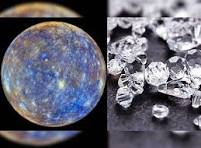
In the vast expanse of our universe, certain celestial bodies challenge our understanding of planetary formation and composition. Among these intriguing discoveries is 55 Cancri e, a “super-Earth” that has captivated astronomers with its unique characteristics.
Discovery and Characteristics
Located approximately 40 light-years away in the constellation of Cancer, 55 Cancri e is one of five planets orbiting the sun-like star 55 Cancri. This exoplanet boasts a radius twice that of Earth and a mass eight times greater, classifying it as a super-Earth. Remarkably, it completes an orbit around its host star in just 18 hours, a testament to its close proximity and rapid orbital speed. Surface temperatures on 55 Cancri e soar to about 3,900 degrees Fahrenheit (2,148 degrees Celsius), rendering it an inhospitable world.

A Diamond-Rich Composition
Initial assumptions about 55 Cancri e’s composition suggested a similarity to Earth’s, with the presence of super-heated water. However, a pivotal study led by Yale University researchers in 2012 proposed a different narrative. Analyzing the planet’s mass, radius, and the carbon-rich nature of its host star, the team inferred that 55 Cancri e might be predominantly composed of carbon (in the forms of graphite and diamond), iron, silicon carbide, and possibly silicates. They estimated that at least a third of the planet’s mass could be diamond, equating to about three Earth masses.
Implications of a Carbon-Rich World
The concept of a carbon-rich planet like 55 Cancri e offers profound insights into planetary formation and diversity. Such a composition suggests that rocky planets can have chemical makeups vastly different from Earth’s, influencing their geophysical processes, atmospheric development, and potential for hosting life. For instance, a diamond-rich interior could affect the planet’s thermal evolution, tectonic activity, and magnetic field generation.
Broader Context and Future Research
The discovery of 55 Cancri e aligns with other findings that hint at the existence of diamond-rich planets. For example, in 2011, researchers identified a planet orbiting a pulsar that was likely composed largely of crystalline carbon, or diamond. These discoveries underscore the diversity of planetary systems and the myriad possibilities for planet compositions beyond our solar system.
As detection methods and analytical techniques advance, astronomers anticipate uncovering more such exotic worlds. Future observations, particularly those focusing on the atmospheres and orbital dynamics of these planets, will be crucial in validating their compositions and understanding their formation histories.
55 Cancri e stands as a testament to the universe’s ability to craft worlds that defy our terrestrial expectations. Its potential diamond-rich composition not only fascinates but also challenges scientists to rethink planetary formation theories and the potential for diverse planetary environments. As we continue to explore the cosmos, such discoveries remind us of the endless variety and mystery that lie beyond our own planet.