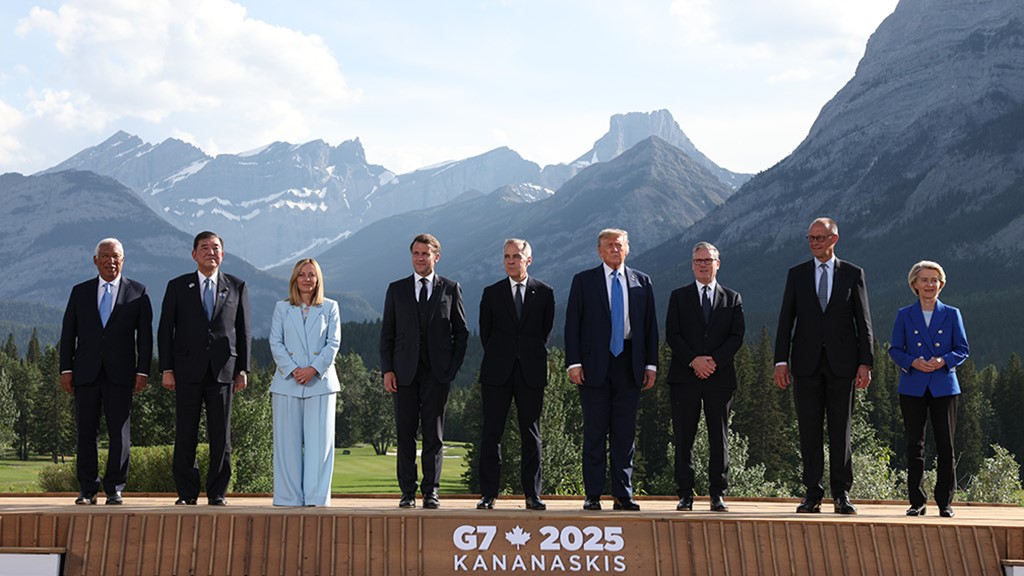
The 51st G7 Summit took place from June 15–17, 2025, in Kananaskis, Alberta, Canada, under Canada’s G7 presidency. Hosted by Prime Minister Mark Carney, the summit brought together leaders from the world’s major advanced economies—including Canada, France, Germany, Italy, Japan, the United Kingdom, the United States—as well as the European Union.
The summit focused on three central themes:
- Protecting communities and the world
- Building energy security and accelerating the digital transition
- Securing the partnerships of the future
Amid global conflicts, trade disputes, and climate challenges, the summit emphasized the importance of collective action and multilateralism.
Leaders Participating
Core G7 Members
- Canada – Prime Minister Mark Carney (Host)
- France – President Emmanuel Macron
- Germany – Chancellor Friedrich Merz
- Italy – Prime Minister Giorgia Meloni
- Japan – Prime Minister Shigeru Ishiba
- United Kingdom – Prime Minister Keir Starmer
- United States – President Donald Trump
- European Union – European Council President António Costa and Commission President Ursula von der Leyen
Outreach Invitees
- India – Prime Minister Narendra Modi
- Australia – Prime Minister Anthony Albanese
- Brazil – President Luiz Inácio Lula da Silva
- Mexico – President Claudia Sheinbaum
- South Africa – President Cyril Ramaphosa
- South Korea – President Lee Jae-myung
- Ukraine – President Volodymyr Zelenskyy
- NATO – Secretary General Mark Rutte
- United Nations – Secretary-General António Guterres
- World Bank – President Ajay Banga
Summit Agenda
- Global Security & Peace
- Ukraine war, Israel–Iran conflict, and Middle East stability.
- Recognition of Israel’s right to self-defense and concerns over Iran.
- No final joint communiqué due to U.S. opposition.
- Energy Security & Digital Transition
- Reinforcing energy resilience.
- Advancing digital infrastructure, cybersecurity, and AI readiness.
- Partnerships for the Future
- Stronger ties with Global South economies.
- Expanding G7 outreach and cooperative initiatives.
- Technology & AI Governance
- Joint statements on artificial intelligence, quantum technologies, critical minerals, migrant smuggling, and transnational repression.
- Trade & Economic Stability
- Critical mineral supply chains, trade resilience, and economic recovery post-pandemic.
- Climate Action & Resilience
- Clean energy transition, climate finance, disaster preparedness, and wildfire response.
- Institutional Challenges & Leadership Dynamics
- Balancing diverse national positions.
- Canada’s role in navigating U.S. unpredictability.
- Lack of a unified communiqué highlighted divisions within the bloc.
Summary Table
| Aspect | Details |
|---|---|
| Dates & Location | June 15–17, 2025 – Kananaskis, Alberta, Canada |
| Host / Chair | Canada – Prime Minister Mark Carney |
| Theme | Protecting communities; energy & digital transition; securing future partnerships |
| Core Members | Canada, France, Germany, Italy, Japan, UK, US, European Union |
| Outreach Invitees | India, Brazil, Mexico, South Africa, South Korea, Australia, Ukraine, key institutions |
| Agenda Highlights | Security, energy, digital, trade, climate, AI governance, Global South outreach |