
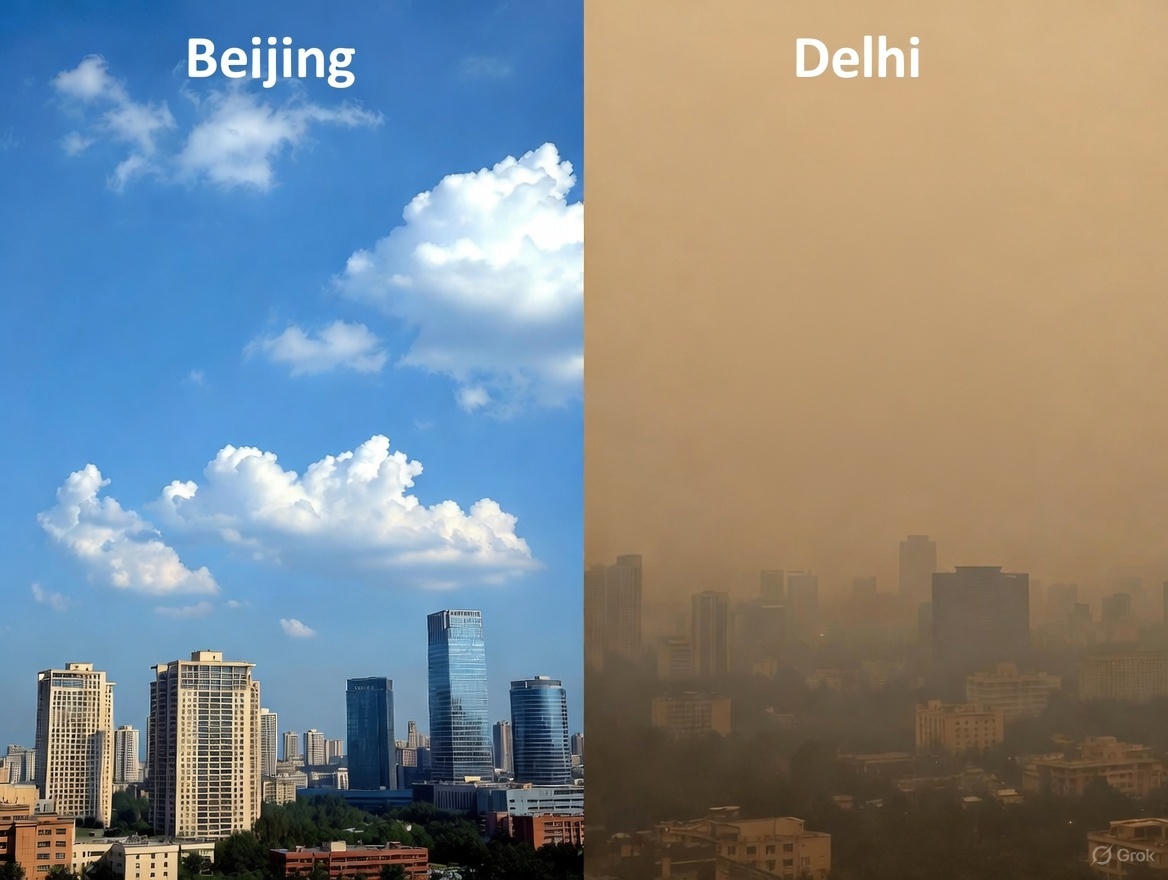
Air pollution has become a pressing global issue, particularly in densely populated megacities. Delhi, India’s capital, frequently tops the list of the world’s most polluted cities, with hazardous smog enveloping the region during winter months, leading to health crises and economic losses. In contrast, Beijing, once infamous as the “smog capital of the world,” has made remarkable strides in improving its air quality over the past decade. This transformation offers valuable insights for Delhi, though adapting these strategies requires considering India’s unique socio-political context.
To illustrate the severity of Delhi’s challenge, here’s a glimpse of the city’s smog-choked skyline:
Beijing’s Pollution Crisis: A Historical Overview
In the early 2000s, Beijing’s air quality was dire. Rapid industrialization, coal-dependent energy, and a booming vehicle population contributed to PM2.5 levels that often exceeded safe limits by several times. The city’s skyline was frequently obscured by thick haze, prompting international concern ahead of events like the 2008 Olympics.
The Turning Point: Beijing’s Comprehensive Cleanup Strategies
Beijing’s turnaround began in earnest with the declaration of a “war on pollution” in 2013. The Chinese government implemented a multi-pronged approach, focusing on key pollution sources:
- Shift from Coal to Cleaner Energy: A major “coal-to-gas” policy was rolled out starting in 2005, reducing coal combustion significantly. This included banning coal-fired boilers, promoting natural gas and renewables, and providing cleaner domestic fuels to households.
- Industrial Restructuring and Emission Controls: Factories were relocated or shut down if they failed to meet strict emission standards. Targeted controls on industrial pollution, combined with a transition to cleaner energy sources, played a pivotal role.
- Vehicle Emissions and Sustainable Mobility: Beijing curbed vehicle emissions through low-emission zones, incentives for electric vehicles, and improved public transportation. Schemes encouraged trading in older, polluting vehicles for more efficient models, reducing the number of cars on the road.
- Urban Greening and Dust Control: Efforts included revamping urban ecosystems, increasing green spaces, and preventing dust pollution from construction sites.
- Strict Enforcement and Monitoring: Rigorous enforcement, backed by a centralized government, ensured compliance. Real-time air quality monitoring and public awareness campaigns supported these measures.
These strategies were enforced with efficiency, allowing for rapid implementation.
Remarkable Results: From Smog to Blue Skies
The outcomes have been impressive. Since 2013, PM2.5 levels in Beijing have dropped substantially, along with reductions in nitrogen dioxide and sulfur dioxide. Today, Beijing’s air quality shows significant improvement compared to previous decades.
Visual evidence of this transformation is striking. Compare these images of Beijing’s air quality from heavily polluted periods to clearer skies in recent years:
Lessons for Delhi: Adapting Beijing’s Playbook
Delhi faces similar challenges—stubble burning, vehicular emissions, industrial pollution, and construction dust—but with added complexities like cross-state coordination and democratic governance. Nonetheless, Beijing’s success provides a roadmap:
- Prioritize Energy Transition: Delhi could accelerate the shift from coal to gas and renewables, banning high-polluting fuels in households and industries.
- Reform Transportation: Implement low-emission zones, promote electric vehicles with subsidies, and expand public transit to reduce private car dependency.
- Industrial and Construction Regulations: Relocate polluting industries, enforce emission norms, and mandate dust control at sites.
- Enhance Green Cover: Increase urban forests and green belts to combat dust and improve air filtration.
- Strengthen Enforcement and Collaboration: While India’s federal system differs from China’s centralized approach, inter-state cooperation, real-time monitoring, and public-private partnerships could enhance enforcement.
China’s experience shows that economic growth and environmental protection can coexist, proving it’s possible for developing nations to tackle pollution without stunting progress.
Challenges and the Path Forward
Beijing’s model relies on strong centralized control, which may not translate directly to Delhi’s democratic framework. Implementation could face resistance from stakeholders, requiring inclusive policies and community involvement. However, with political will, Delhi can adapt these lessons to achieve cleaner air, safeguarding public health and sustainability.
In summary, Beijing’s journey from pollution hotspot to a model city underscores the power of decisive action. Delhi, by learning from this, can aspire to blue skies and breathable air for its residents.