
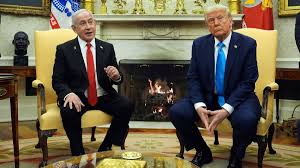
Introduction: A New Phase of U.S. Intervention
The United States has dramatically deepened its involvement in the Israel-Hamas conflict, marking a pivotal shift in its Middle East strategy under President Donald Trump’s renewed administration. Over the past month, the U.S. has transitioned from diplomatic support and military aid to direct strategic collaboration with Israel, including proposed territorial control over Gaza and intensified joint operations against Hamas and Iranian-backed factions . This escalation follows a fragile ceasefire agreement brokered in January 2025, which Trump’s team has leveraged to advance a controversial vision for postwar Gaza while ramping up pressure on Iran .
This article examines the geopolitical, humanitarian, and strategic implications of America’s heightened engagement, analyzing how Trump’s policies are reshaping the conflict and drawing fierce international backlash.
[xyz-ihs snippet=”Love-Calculator”]
1. Historical Context: From Biden’s Diplomacy to Trump’s Hardline Shift
Biden’s Legacy of Unconditional Support
Under President Joe Biden, the U.S. provided Israel with over $30 billion in military aid, shielding it from international condemnation despite widespread allegations of war crimes in Gaza . Biden’s administration facilitated intelligence sharing, missile defense systems, and diplomatic cover at the UN, enabling Israel’s 15-month offensive that killed over 47,000 Palestinians and displaced 90% of Gaza’s population . However, Biden’s efforts to negotiate a two-state solution faltered as Israel expanded settlements in the West Bank and rejected Palestinian statehood .
Trump’s Return: A Radical Reset
Since taking office in January 2025, Trump has pivoted to a more aggressive stance. He has endorsed Israeli Prime Minister Benjamin Netanyahu’s goal of “total victory” over Hamas while proposing that the U.S. “take control” of Gaza to oversee its reconstruction and resettle Palestinians abroad—a plan critics liken to ethnic cleansing . Trump’s Middle East envoy, Steve Witkoff, and Defense Minister Israel Katz have drafted plans to relocate Gazans “voluntarily,” though international law experts warn this violates prohibitions on forced population transfers .
2. Military Escalation: Joint U.S.-Israel Operations
Direct Involvement in Gaza and Beyond
The U.S. has expanded its military footprint in the region, deploying advanced THAAD missile defense systems in Israel and conducting joint airstrikes with the UK against Houthi rebels in Yemen . Recent reports suggest Trump is considering preemptive strikes on Iran’s nuclear facilities, a move Netanyahu has long advocated . Meanwhile, Israeli forces—armed with U.S.-made F-35 jets and precision-guided munitions—have intensified raids in Gaza’s north, targeting Hamas tunnels and displacing thousands of civilians .
The Hostage Crisis and Ceasefire Fractures
A temporary ceasefire in January 2025 saw the release of 18 Israeli hostages and 2,000 Palestinian prisoners, but negotiations for the second phase have stalled. Hamas accuses Israel of violating terms by blocking aid and attacking returnees to northern Gaza, while Netanyahu faces pressure from far-right allies to resume full-scale war . Trump’s threats of “hell to pay” if hostages remain captive have further destabilized talks, with families of hostages pleading for urgency amid reports of starvation and torture in Hamas captivity .
3. The Gaza Takeover Proposal: Controversy and Consequences
Trump’s Vision for a “U.S.-Owned” Gaza
Trump’s plan to transform Gaza into a “spectacular development” under U.S. oversight has sparked global outrage. He claims Arab nations will fund new settlements for Palestinians outside Gaza, but Egypt, Jordan, and Turkey have rejected this as a “second Nakba,” referencing the 1948 displacement . Hamas leader Izzat al-Rishq condemned the proposal as “absurd,” while Saudi Arabia and Qatar insist any deal must include Palestinian statehood .
Humanitarian Catastrophe and Legal Reckoning
Gaza’s infrastructure lies in ruins: hospitals, schools, and water systems have been destroyed, and famine looms as Israel restricts aid . The International Criminal Court (ICC) has issued arrest warrants for Netanyahu and former Defense Minister Yoav Gallant for crimes against humanity, but the U.S. Congress has moved to sanction the ICC, shielding Israeli leaders . Legal scholars argue Trump’s resettlement plan could implicate the U.S. in violations of the Geneva Conventions .
4. Regional and Global Reactions
Arab States: Unity Against Displacement
Egypt and Jordan have led regional opposition to Trump’s policies, hosting emergency summits to reaffirm support for Palestinian self-determination . Turkey’s President Recep Tayyip Erdogan accused the U.S. of “exiling Palestinians from their ancestral land” and demanded Israel pay reparations for Gaza’s destruction . Meanwhile, Saudi Arabia conditions normalization with Israel on a credible path to Palestinian statehood—a nonstarter for Netanyahu’s government .
International Diplomacy in Disarray
The UN Security Council remains deadlocked, with the U.S. vetoing ceasefire resolutions. European allies like France have condemned Israel’s “barbarism,” but Trump’s leverage over NATO has muted unified action . China and Russia, seeking to capitalize on U.S. isolation, have called for multilateral peace talks, though their influence remains limited .
5. The Road Ahead: Risks and Uncertainties
Iranian Escalation and Proxy Warfare
A potential U.S.-Israel strike on Iran’s nuclear facilities risks triggering a regional war. Iran’s allies—Hezbollah in Lebanon and Houthis in Yemen—have already stepped up attacks, while Syria’s destabilization post-Assad adds another flashpoint . Trump’s alignment with Netanyahu’s hawkish agenda could further entangle the U.S. in a broader Middle East conflict.
Domestic Pressures in Israel and the U.S.
Netanyahu’s coalition is fracturing, with far-right ministers threatening to collapse the government if the war pauses . In the U.S., progressive lawmakers and human rights groups demand an end to military aid, while Trump’s base applauds his “peace through strength” approach . The 2024 U.S. election, which saw 65% of Israelis favor Trump over Kamala Harris, underscores the political stakes .
The Illusion of “Victory”
Despite claiming to have destroyed 80% of Hamas’ infrastructure, Israel has failed to rescue all hostages or eliminate Hamas’ leadership. Experts warn that without a political solution, militant groups will resurge, perpetuating cycles of violence .
Conclusion: A Precarious Crossroads
America’s deepened involvement in the Israel-Hamas war reflects Trump’s embrace of unilateralism and disregard for international norms. While his administration touts “historic” opportunities for Middle East peace, the reality is a fractured region, a humanitarian nightmare in Gaza, and escalating tensions with Iran. The path forward demands urgent diplomacy, accountability for atrocities, and a recommitment to Palestinian rights—steps Trump’s policies currently reject. As the world watches, the stakes for global stability have never been higher.